A Groove-billed Ani and the Case for Chasing Strays
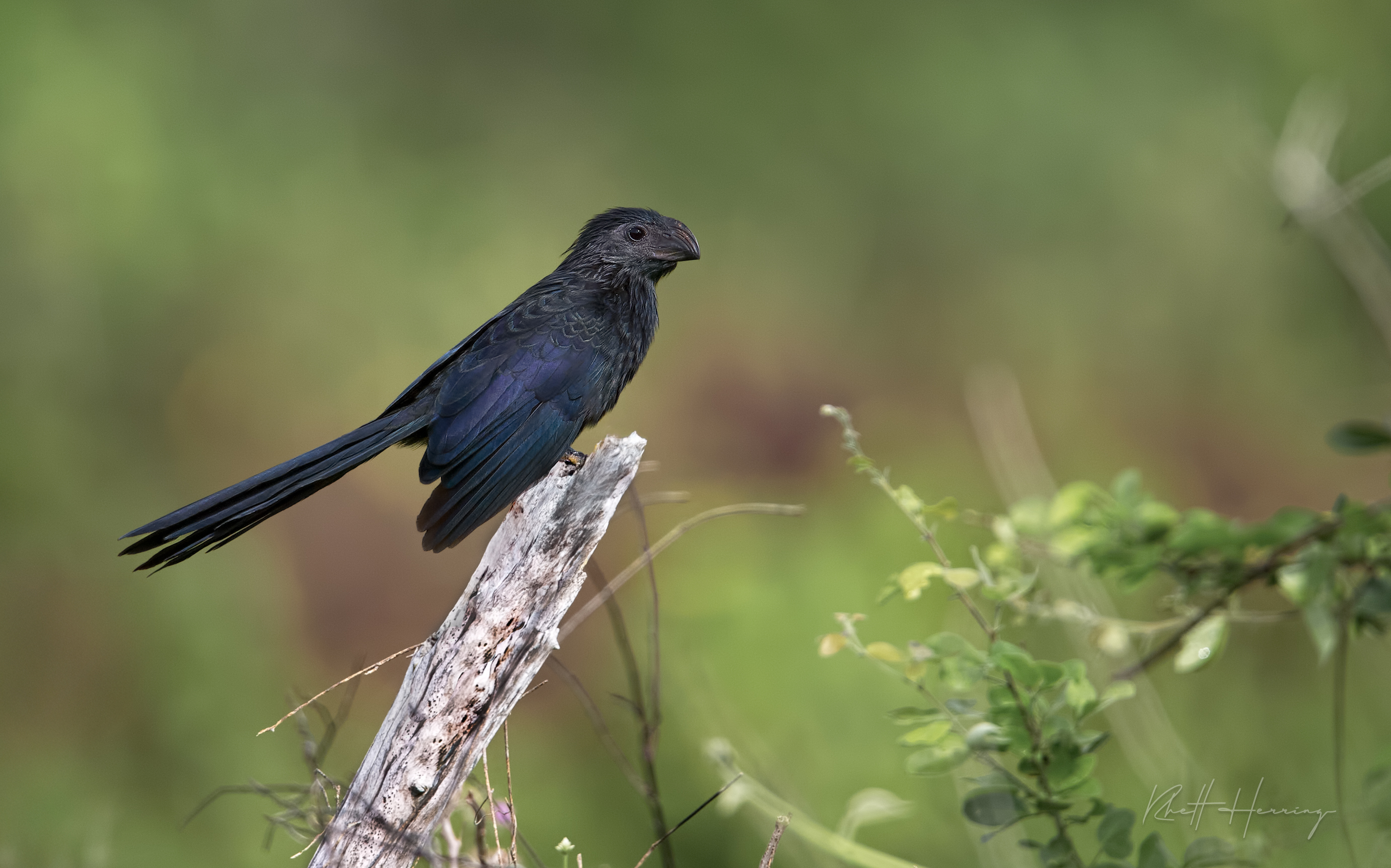
This one wasn't shot in Arizona, and I want to be straight about that up front. This image came was taken in Mexico back in October of 2014, on a morning when the light stayed soft and green longer than it had any right to. But I keep coming back to it because the bird in question, the Groove-billed Ani, is exactly the kind of oddball that gets Arizona birders driving through the night to a cattle tank in Cochise County.
If you've never seen an ani, the shape throws you first. It's a member of the cuckoo family, all loose feathers and a tail that seems borrowed from a bigger bird. Then there's the bill. Deep, laterally compressed, ridged with those fine grooves that give the species its name, it looks less like a beak and more like a small hatchet stuck on the front of its face. In flat light an ani reads as plain black. Catch the angle right, the way I did here, and the wings and tail go slick with blue and violet, an oily sheen that only shows up when the sun works across the feathers.
This individual was sitting on a bleached, beetle-drilled snag at the edge of some brush, doing that thing anis do where they seem to have all the time in the world. They're clumsy, social birds. They move in loose groups, hopping around cattle and flushing grasshoppers, and they nest communally, several females laying in one big untidy bowl. There's something appealing about a bird that doesn't bother pretending to be graceful.
So why does it matter to an Arizona shooter? Because Groove-billed Anis wander. Most falls, a few push north out of Mexico and turn up in southeast Arizona, usually along the San Pedro or in mesquite bosque near water. They're not annual in numbers, and when one settles in, word travels fast. I've stood at a stock pond near Hereford with a small crowd of people, everyone quiet, waiting for a black lump to peel up out of the tamarisk. That anticipation is half the reason I love chasing rarities.
Technically this frame was patience more than skill. I worked from low, kept the sun over my shoulder, and let that wall of out-of-focus green do the heavy lifting. The pale snag against the dark bird gives the eye somewhere to land. I shot wide open to melt the background and waited for the head to turn just off profile so the catchlight showed and that pale bill separated cleanly from the shadowed body.
If you bird the borderlands in October, keep an eye on the fencelines and the messy edges. The ani won't announce itself with color. Look for the shape, the long swinging tail, the ridiculous bill. And when one crosses into Arizona, go. Those are the mornings you remember.