A Male Anna's Hummingbird, Caught Mid-Pivot
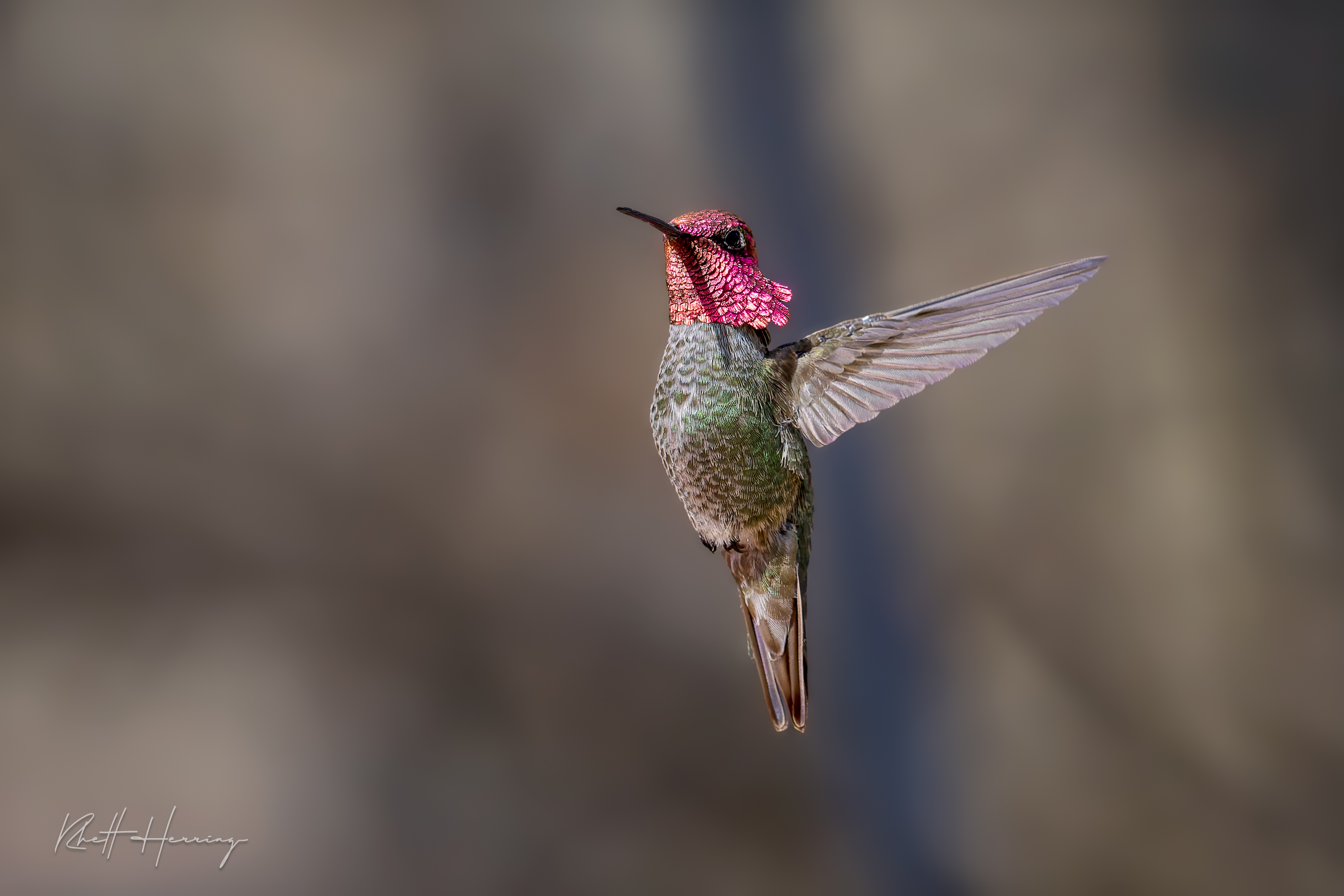
This is a male Anna's Hummingbird, and if you've spent any time around feeders in Arizona, you already know the type. They're the loudmouths. The ones that perch on the highest twig and buzz at anything that drifts into their airspace, including you. Anna's used to be a coastal California bird, but they've pushed east and south over the decades, and now they're year-round residents across a lot of the state. Mine never leave. I had this one working the salvia and the feeder all winter.
I shot this on the morning of March 30th, in my own yard, which I'll admit is the least adventurous location I've ever filed a photo under. No hike, no dawn drive into the desert. Coffee in one hand, camera on a tripod near the patio. The light was that flat, cool gray you get before the sun clears the neighbor's roofline, and I was almost ready to pack it in. Then he came in to hover near the feeder and turned his head a few degrees toward me.
That turn is everything with an Anna's. The gorget and crown aren't pigment, they're structural color. The feathers act like tiny prisms, so the magenta only ignites when the light hits at the right angle and bounces back to your lens. A few degrees off and the whole face reads dull bronze or near black. People see a shot like this and assume I added saturation. I didn't. I just got lucky with the geometry, and luck plus a fast shutter is most of what hummingbird photography actually is.
Settings were nothing exotic. I was up around 1/3200 to freeze the body, wide open to throw that adobe wall behind him into a soft wash of brown and slate. Even at that speed the wingtips stay a little soft, which I've made peace with. A hummingbird beats its wings something like fifty times a second, and I'd rather keep the head and that pinned dark eye tack sharp than chase a frozen wing and lose the face. The raised right wing here, caught at the top of its stroke, is the kind of thing you get one frame out of forty.
If you want males in full color, work the angles, not just the bird. Put the morning sun behind you and a little low, and be patient while he repositions. They display by flaring the gorget and pivoting, so the color comes to you if you hold still long enough. A clean, distant background helps too. Mine here was just a stuccoed wall fifteen feet back, but at the right aperture it turns to nothing, and nothing is exactly what you want behind a bird like this.
Best part is you don't need to go far. Plant some tubular flowers, keep a clean feeder, and the Anna's will find you. Then it's just a matter of being out there with the camera when one decides to turn his head.